
1
Specialist professionals
Specialist teacher assessors and psychologists.
5 hours of SASC authorised CPD
Understanding DCD/Dyspraxia in SpLD Assessment
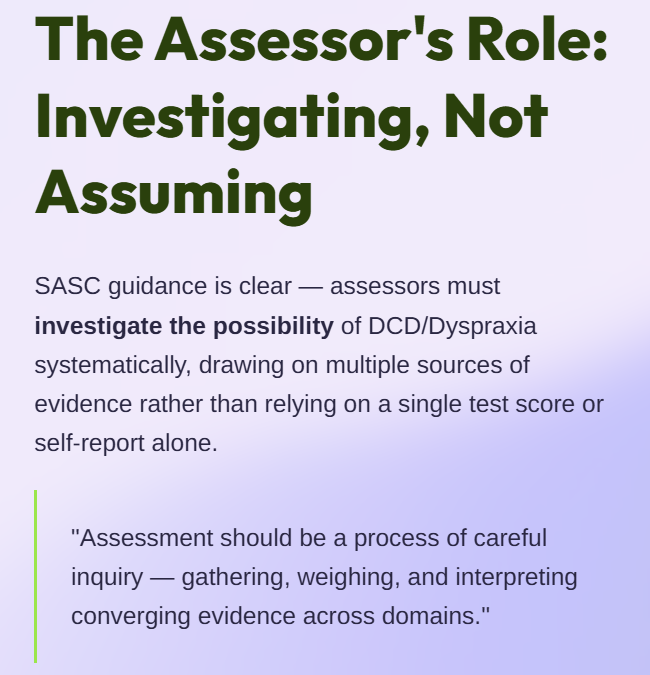
A practical course led by Katherine Kindersley and Jen McDermott to help you investigate the possibility of DCD/Dyspraxia across age groups, report sensitively, and make recommendations that genuinely move the individual forward.
Practical professional learning
Is this you?
You want to sign your reports feeling confident that you have explored the profile thoroughly and made appropriate recommendations, including where there may be indicators of DCD/dyspraxia.
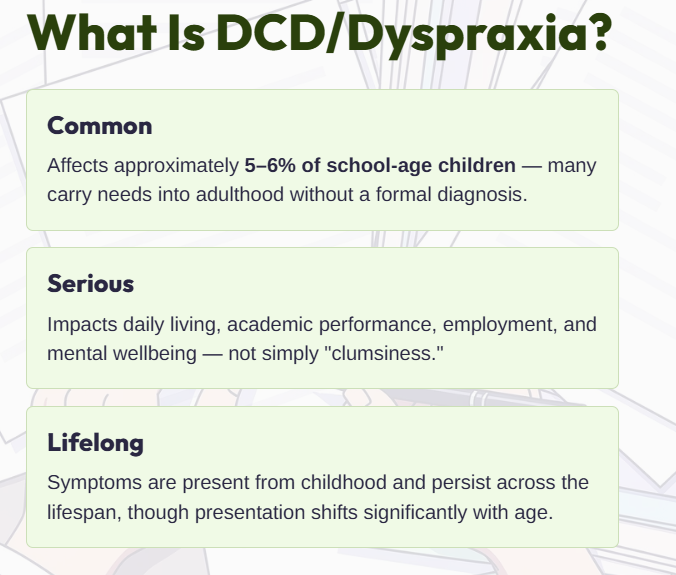
Because it is about far more than “just being clumsy”. Yet there is rarely a neat or predictable cognitive pattern, and overlaps with other SpLDs can easily muddy the picture. You want to be accurate without over-exploring.
You want to stay within professional boundaries without missing the things that matter most. And you want to make sure your report language is both safe and sensitive.
Good news: this course gives you a clear framework to investigate DCD/Dyspraxia and write it up in a way that’s both professional and usable.
Why this matters
There is rarely a neat or predictable cognitive pattern, and overlaps with other SpLDs can easily muddy the picture.
Who this is for
Specialist teacher assessors and psychologists.
Assessors working with children, students and adults.
Anyone wanting to strengthen practice in line with updated SASC guidance and the 2025 report format.
It’s especially helpful if you want a firmer framework for those “complex profile” cases where coordination is part of the picture.
Beyond the assessment
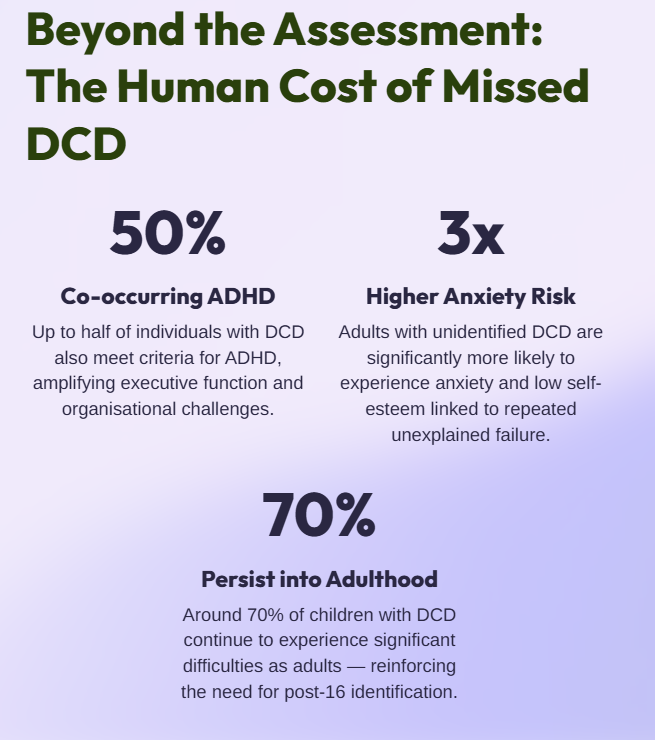
Accurate investigation, sensitive reporting and practical recommendations can make a meaningful difference across education, employment and daily life.
Extended 120-day enrolment with unlimited access.
Meet your trainers

Senior Trainer
Katherine founded and directed Dyslexia Assessment and Consultancy, an organisation of specialist teacher assessors and psychologists, which for 25 years provided specialist assessment and support, as well as training and advice on reasonable adjustments. She ran regular training courses for professionals on all aspects of SpLD diagnostic assessment as well as dyslexia awareness for managers. She is a qualified expert witness. She was the co-author with A. Jones of ‘Dyslexia: Assessment & Reporting’, The Patoss Guide, Hodder Education. Since 2011, she has been involved with meetings and discussions to develop guidance on DCD /dyspraxia for those in education and employment, working with Professors Anna Barnett, Amanda Kirby and Elisabeth Hill as well as supporting the guidance for SASC, formally published in in 2020 and in 2025. She worked alongside Professor Asherson and Dr Anna Smith, to develop the SASC ADHD guidance published in 2021. She has been at the heart of the ongoing work to develop the assessment report formats and all the changes over recent years. She has been a Director of SASC since 2013.

Senior Trainer
Jen is an experienced independent specialist teacher assessor with a career spanning 25 years across differing age ranges and educational settings. Her vital role with Patoss as the Lead of the Assessment Practising Certificate (APC) Review Team contributed to the promotion of best practices across the profession. It underpinned the many focused training courses Jen developed and delivered to support assessors as they prepared to renew their APC and in the ongoing development of their professional practice. Jen believes in the importance of working collaboratively. She has been an active member of the Patoss Board as well as its senior management team. She currently serves as a Director of the SpLD Assessment Standards Committee (SASC) having joined the Board in 2014. This role demonstrates her commitment to the highest standards in diagnostic assessment and to the support of fellow professionals who strive to achieve these standards. Her central contribution over the years to the development and effective evolution of the diagnostic assessment report format, its implementation and interpretation exemplifies her commitment to work positively with her colleagues and others.
Ready to grow in confidence?
Join this DCD/Dyspraxia core training and feel more confident when considering potential co-occurrence.